DQN with Prioritized Experience Replay (PerDQN)
论文链接: https://arxiv.org/pdf/1511.05952
基于优先经验回放的 DQN(PER DQN)是传统 DQN 的一种变体。 该算法引入优先经验回放机制,通过在训练过程中优先使用某些经验, 提升智能体的学习效率。
下表列出了 PER DQN 算法的一些基本特征:
PER DQN 的特征 |
是否具备 |
说明 |
|---|---|---|
同策略(On-policy) |
❌ |
评估策略与目标策略相同。 |
异策略(Off-policy) |
✅ |
评估策略与目标策略不同。 |
无模型(Model-free) |
✅ |
无须预先构建环境动力学模型。 |
基于模型(Model-based) |
❌ |
需要使用环境模型训练策略。 |
离散动作 |
✅ |
可处理离散动作空间。 |
连续动作 |
❌ |
可处理连续动作空间。 |
方法
在标准的 DQN 中,经验被存储在经验回放缓冲区中, 智能体从缓冲区中均匀采样经验,以训练其 Q 网络。 然而,均匀采样的效率可能较低,尤其是当某些经验对学习比其他经验更加重要时。 PER DQN 通过优先采样那些预计能够为策略改进提供更多有效信息的经验,解决这一问题。
优先经验回放
在优先经验回放(Prioritized Experience Replay,PER)中,经验不再从缓冲区中被均匀采样,而是根据其时序差分(Temporal-Difference,TD)误差确定优先级。
TD 误差是期望 Q 值(由 Bellman 方程得到)与智能体 Q 网络当前预测的 Q 值之间的差异。
较大的 TD 误差意味着该经验具有较高的学习潜力,因为它表明智能体当前的 Q 函数未能准确预测该经验对应的未来回报。
PER DQN 的工作原理
在 PER DQN 中,经验回放缓冲区增加了优先采样机制。某条经验的优先级与其 TD 误差成正比。
当智能体为训练采样经验时,TD 误差较大的经验更有可能被选中。
这种方式使智能体将学习重点放在更出乎预期或更困难的经验上,并通过更加频繁地重新使用重要经验来加快学习过程。
重要性采样
为了避免因优先采样经验而使训练过程产生偏差,PER DQN 使用了重要性采样。 每条经验都会被赋予一个用于补偿非均匀采样的权重。 这可以确保即使经验不是均匀采样的,智能体仍然能够进行正确学习。
数学细节
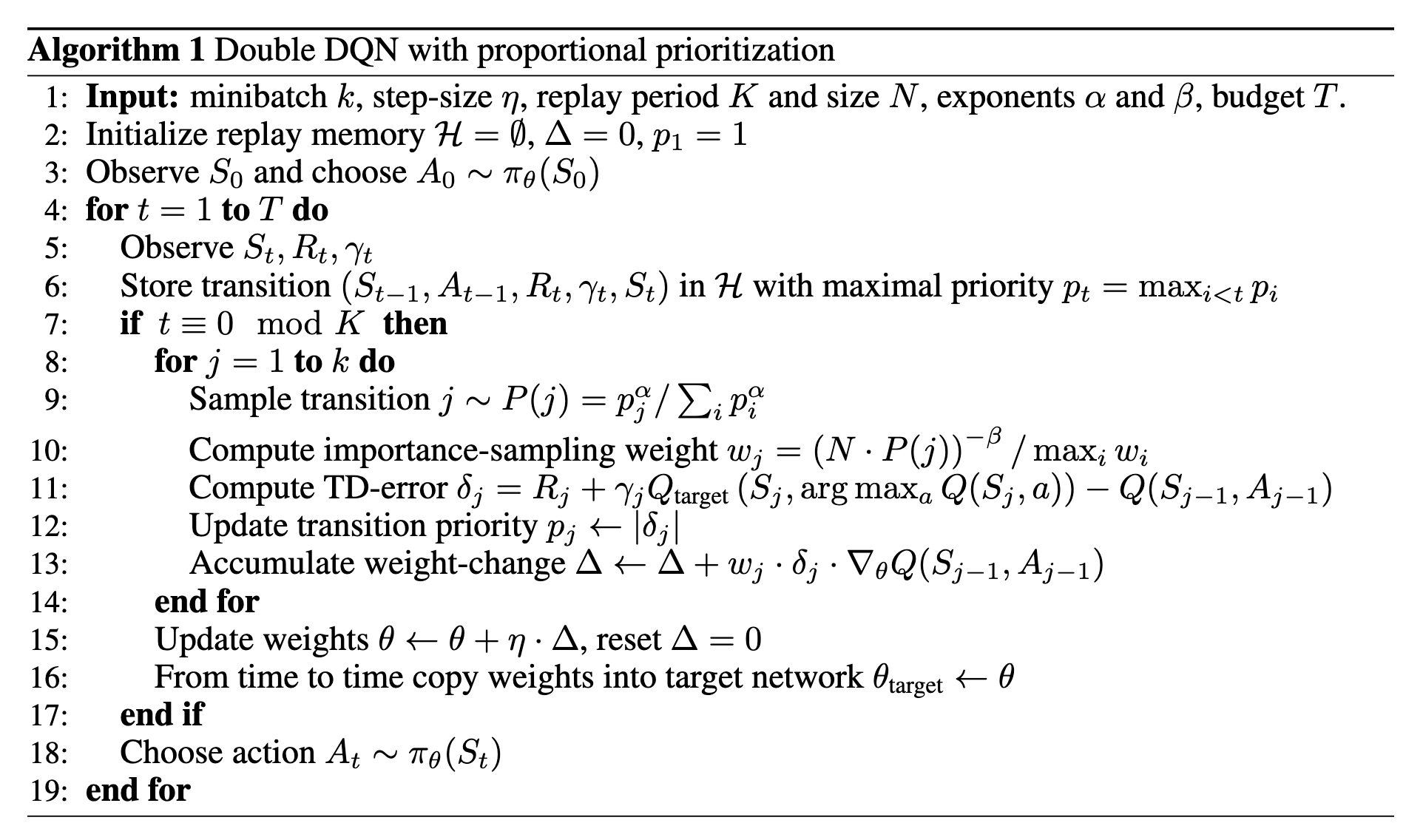
经验 \(i\) 的优先级 \(p_i\) 使用 TD 误差 \(\delta_i\) 计算,通常表示为:
其中,\(|\delta_i|\) 是 TD 误差的绝对值; \(\epsilon\) 是一个较小的常数,用于确保 TD 误差为零的经验仍然能够被保留在缓冲区中并参与采样。
经验 \(i\) 被采样的概率为:
其中,\(\alpha\) 用于控制优先采样的程度,即 TD 误差对采样概率的影响程度。
算法
用于训练 PER DQN 的完整算法如算法 1 所示:
在 XuanCe 中运行 PER DQN
在 XuanCe 中运行 PER DQN 之前,需要先准备一个 conda 环境,并按照
安装步骤安装 xuance。
运行内置示例
完成安装后,可以打开 Python 控制台,并使用以下命令直接运行 PER DQN:
import xuance
runner = xuance.get_runner(method='perdqn',
                           env='classic_control',  # 可选项:claasi_control、box2d、atari。
                           env_id='CartPole-v1',  # 可选项:CartPole-v1、LunarLander-v2、ALE/Breakout-v5 等。
                           is_test=False)
runner.run()  # 也可以使用 runner.benchmark()
使用自定义配置运行
如需使用不同配置运行 PER DQN,可以新建一个 .yaml 文件,例如 my_config.yaml。
然后使用以下代码运行 PER DQN:
import xuance as xp
runner = xp.get_runner(method='perdqn',
                       env='classic_control',  # 可选项:claasi_control、box2d、atari。
                       env_id='CartPole-v1',  # 可选项:CartPole-v1、LunarLander-v2、ALE/Breakout-v5 等。
                       config_path="my_config.yaml",  # 请确保 my_config.yaml 文件的路径正确。
                       is_test=False)
runner.run()  # 也可以使用 runner.benchmark()
如需进一步了解配置方法,请参阅 配置教程。
在自定义环境中运行
如需在 XuanCe 尚未包含的自定义环境中运行 PER DQN,
需要按照 新环境教程
中的步骤定义新环境。
然后,准备配置文件
perdqn_myenv.yaml。
完成上述操作后,可以使用以下代码在自定义环境中运行 PER DQN:
import argparse
from xuance.common import get_configs
from xuance.environment import REGISTRY_ENV
from xuance.environment import make_envs
from xuance.torch.agents import PerDQN_Agent

configs_dict = get_configs(file_dir="perdqn_myenv.yaml")
configs = argparse.Namespace(**configs_dict)
REGISTRY_ENV[configs.env_name] = MyNewEnv

envs = make_envs(configs)  # 创建并行环境。
Agent = PerDQN_Agent(config=configs, envs=envs)  # 创建一个来自 XuanCe 的 DDPG 智能体。
Agent.train(configs.running_steps // configs.parallels)  # 对模型进行多个步骤的训练。
Agent.save_model("final_train_model.pth")  # 将模型保存到 model_dir。
Agent.finish()  # 结束训练。
参考文献
@inproceedings{DBLP:journals/corr/SchaulQAS15,
  author       = {Tom Schaul and
                  John Quan and
                  Ioannis Antonoglou and
                  David Silver},
  editor       = {Yoshua Bengio and
                  Yann LeCun},
  title        = {Prioritized Experience Replay},
  booktitle    = {4th International Conference on Learning Representations, {ICLR} 2016,
                  San Juan, Puerto Rico, May 2-4, 2016, Conference Track Proceedings},
  year         = {2016},
  url          = {http://arxiv.org/abs/1511.05952},
  timestamp    = {Thu, 25 Jul 2019 14:25:38 +0200},
  biburl       = {https://dblp.org/rec/journals/corr/SchaulQAS15.bib},
  bibsource    = {dblp computer science bibliography, https://dblp.org}
}