软演员—评论家算法(SAC)
论文链接:arXiv。
软演员—评论家算法(Soft Actor-Critic,SAC)是一种先进的无模型深度强化学习算法,它将演员—评论家框架与最大熵强化学习原理相结合。SAC 于 2018 年提出,凭借其处理连续动作空间的能力,以及在多种复杂任务中的稳定表现,受到了广泛关注。
下表列出了 SAC 算法的一些基本特征:
SAC 的特征 |
是否具备 |
说明 |
|---|---|---|
同策略(On-policy) |
❌ |
评估策略与目标策略相同。 |
异策略(Off-policy) |
✅ |
评估策略与目标策略不同。 |
无模型(Model-free) |
✅ |
无须预先构建环境动力学模型。 |
基于模型(Model-based) |
❌ |
需要使用环境模型训练策略。 |
离散动作 |
✅ |
可处理离散动作空间。 |
连续动作 |
✅ |
可处理连续动作空间。 |
SAC 的核心思想
基于最大熵的目标函数:
传统强化学习的目标是最大化期望奖励之和。相比之下,SAC 采用的最大熵强化学习目标为:
其中:
\(\mathcal{H}(\pi(\cdot|s_t))\) 表示策略 \(\pi\) 在状态 \(s_t\) 下的熵;
\(\alpha\) 是控制熵项重要程度的超参数。
该目标函数引入了 \(\alpha\mathcal{H}(\pi(\cdot|s_t))\) 熵项,鼓励智能体在追求高奖励的同时保持一定程度的随机性,从而增强探索能力。温度参数 \(\alpha\) 决定熵项相对于奖励项的重要程度,并控制最优策略的随机程度。当 \(\alpha=0\) 时,该目标退化为传统的最大期望回报目标。这样的目标设计使智能体能够在复杂环境中探索多种行为模式,并找到更优的策略。
双 Q 网络设计:
为减轻 Q 值的过估计问题,SAC 使用两个评论家网络。每个评论家网络分别估计状态—动作对的价值,并使用两个 Q 值中的较小值计算目标 Q 值。该设计能够有效降低 Q 值估计偏差,并提高算法的稳定性。
软更新机制:
SAC 使用软更新机制更新目标网络,以提高训练稳定性。具体而言,目标网络参数按照以下方式更新:
其中,\(\tau\) 是一个较小的正数,通常取 0.005。软更新机制能够平滑目标网络的参数更新,避免目标网络参数发生剧烈变化。
算法
训练 SAC 的完整算法如算法 1 所示:
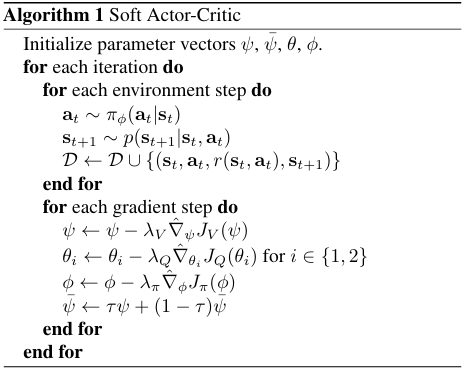
补充说明: TD3 和 SAC 在多个方面具有相似性,包括网络结构、双 Q 网络设计、软更新机制、训练稳定性、适用场景、实现特点、优化目标和实际应用价值。这些相似性使二者在处理连续动作空间任务时都能取得良好表现。不过,它们在探索机制和策略类型方面存在差异,因此在不同任务中的适用性和性能也有所不同。
参阅 TD3 算法。
在 XuanCe 中运行 SAC
在 XuanCe 中运行 SAC 之前,需要先准备一个 conda 环境,并按照
安装步骤安装 xuance。
运行内置示例
完成安装后,可以打开 Python 控制台,并使用以下命令直接运行 SAC:
import xuance
runner = xuance.get_runner(method='SAC',
                           env='classic_control',  # 可选项:classic_control、box2d、atari。
                           env_id='Pendulum-v1',
                           is_test=False)
runner.run()  # 也可以使用 runner.benchmark()
使用自定义配置运行
如需使用不同配置运行 SAC,可以新建一个 .yaml 文件,例如
my_config.yaml。然后使用以下代码运行 SAC:
import xuance as xp
runner = xp.get_runner(method='SAC',
                       env='classic_control',  # 可选项:classic_control、box2d 等。
                       env_id='Pendulum-v1',
                       config_path="my_config.yaml",  # 请确保 my_config.yaml 文件的路径正确。
                       is_test=False)
runner.run()  # 也可以使用 runner.benchmark()
如需进一步了解配置方法,请参阅 配置教程。
在自定义环境中运行
如需在 XuanCe 尚未包含的自定义环境中运行 SAC,需要按照
新环境教程
中的步骤定义新环境。
然后,准备配置文件
SAC_myenv.yaml。
完成上述操作后,可以使用以下代码在自定义环境中运行 SAC:
import argparse
from xuance.common import get_configs
from xuance.environment import REGISTRY_ENV
from xuance.environment import make_envs
from xuance.torch.agents import SAC_Agent

configs_dict = get_configs(file_dir="SAC_myenv.yaml")
configs = argparse.Namespace(**configs_dict)
REGISTRY_ENV[configs.env_name] = MyNewEnv

envs = make_envs(configs)  # 创建并行环境。
Agent = SAC_Agent(config=configs, envs=envs)  # 创建一个来自 XuanCe 的 SAC 智能体。
Agent.train(configs.running_steps // configs.parallels)  # 对模型进行多个步骤的训练。
Agent.save_model("final_train_model.pth")  # 将模型保存到 model_dir。
Agent.finish()  # 结束训练。
参考文献
@inproceedings{haarnoja2018soft,
  title={Soft actor-critic: Off-policy maximum entropy deep reinforcement learning with a stochastic actor},
  author={Haarnoja, Tuomas and Zhou, Aurick and Abbeel, Pieter and Levine, Sergey},
  booktitle={International conference on machine learning},
  pages={1861--1870},
  year={2018},
  organization={PMLR}
}